
Wagoner County's Most Wanted Program
The Wagoner County Sheriff's Office runs a Most Wanted page built for tips, not for research. It has a Search Most Wanted control, a Submit a Tip option, public field labels, and a plain warning: do not try to apprehend anyone yourself. Treat it as a curated public-safety feature rather than a Wagoner County warrant ledger. It is no court docket, and it settles nothing about a case. The sheriff's own cautions matter here. Entries can be inaccurate or out of date, since accounts get satisfied and the page updates routinely. The case amount shown can shift too, because fees, payments, and penalties change the balance. What the official page shows is a working tool for reporting, so call in a tip and leave the rest to the issuing court.
The official Wagoner County Most Wanted page runs the live program and posts its own instructions.
How the Most Wanted Lists Work
The Wagoner County page shows a selection, not a roster. It publishes no total count, no "as of" date, no pagination, no export button, and no filter by issuing court, and there is no fixed refresh schedule. The visible labels cover race, eye color, bond amount, sex, hair color, last known location, aliases, and a wanted-for description. That describes the interface only. The page has also said it was in the middle of updating its list, so a featured entry can lag behind a payment, a recall, an arrest, or other court action. Treat "listed" as publicly featured, not proven active today.
What “Search Most Wanted” Does Not Promise
Search Most Wanted does not search full names across Wagoner County District Court, every municipal court, OLETS, ODIS, or federal systems. It publishes no matching rules, no alias behavior, and no status-code key. A no-result page is not a no-warrant answer.
Program boundary: use the official page for its public-safety feature and tip route, then contact the issuing court or sheriff for a personal record question.
In Wagoner County, each tool answers one narrow question. The sheriff's inmate search is a custody lookup; OSCN and ODCR are public case-search systems; city portals handle citations and payments.
Reporting a Tip Safely
To report something in Wagoner County, call 918-485-3124 or use Submit a Tip, which routes anonymous information to investigators. The sheriff's home page also lists a crime-tip hotline at 918-485-7799 plus an online submission path. No reward amount, eligibility rule, or payout process is published, so assume none.
Safety rule: do not approach or try to apprehend anyone shown on an official law-enforcement list. Send information through the published sheriff or tip channel.
A tip line is not a warrant check. For your own Wagoner County case status, call the issuing clerk, the sheriff, your lawyer, or the court directly.
The Sheriff App's Program Layer
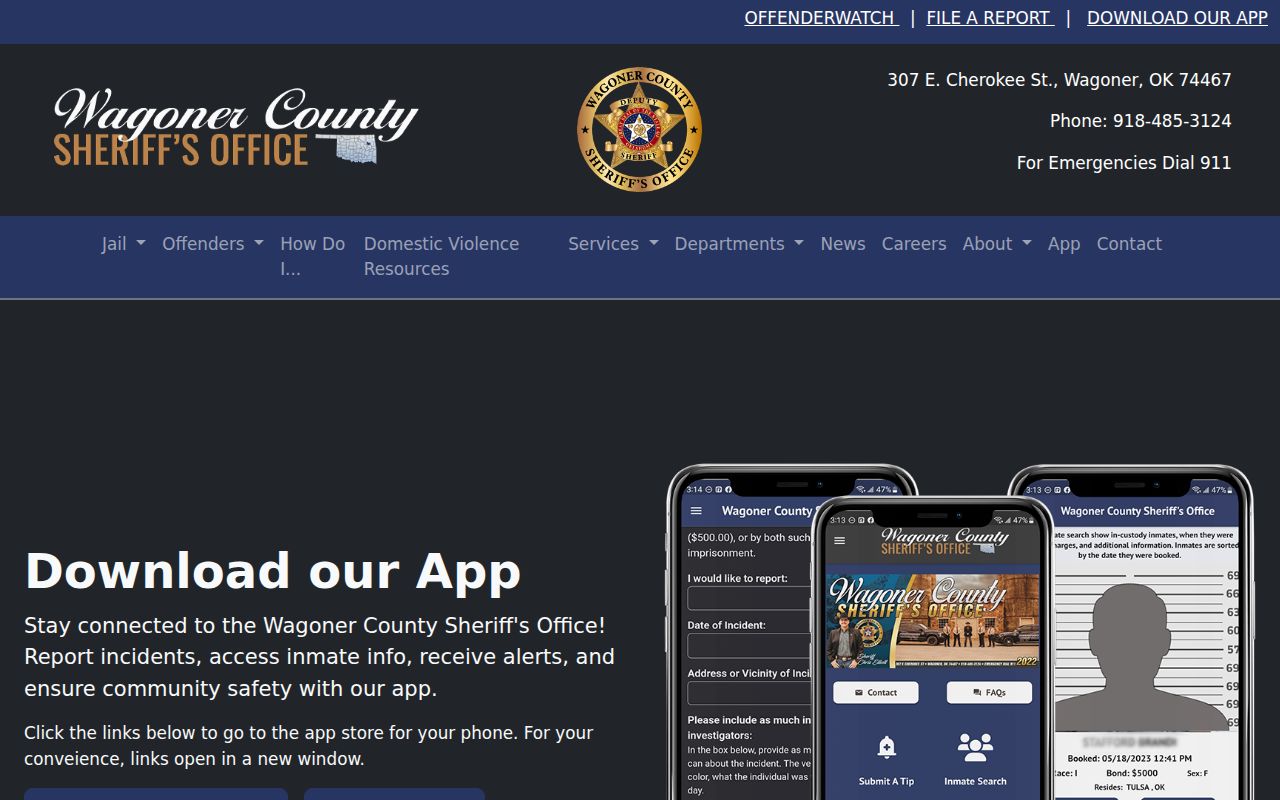
The sheriff's app page advertises inmate information, wanted persons, tips, alerts, and sheriff contacts for Wagoner County. The public landing page shows no live fields, no update behavior, and no app-store link. So treat the app as one more agency channel, not proof of instant sync with courts or law-enforcement systems. That page shows navigation and service descriptions only. For current routing, the sheriff's phone still comes first.
Do not send a Wagoner County tip just to ask whether a warrant exists. The tip function belongs to investigators.
Routine Updating and List Lag
The official Wagoner County disclaimer says the list updates routinely, with no fixed schedule, and that accounts may be satisfied while approximate amounts change. Two errors follow. A displayed entry may lag a court action. A current Wagoner County court warrant may never be featured at all. If the page is mid-update or a search comes up empty, move on to the likely issuing court. OSCN or ODCR works for a public District Court case. A municipal clerk handles a city ticket. For sheriff or custody routing, call 918-485-3124.
Most Wanted Lists vs Active Warrants
These labels do not swap. Most Wanted is a curated Wagoner County safety feature. An active warrant is a status question in a court or agency record. An inmate listing is custody data, a city payment portal is a vendor channel, and the Court Clerk is the county District Court's file and bond counter.
| Source | What it can show | What it cannot establish alone |
|---|---|---|
| Most Wanted page | Featured public-safety entry and tip route | Every active county or city warrant |
| OSCN or ODCR | Public District Court case events | Live status for every agency |
| City portal | Citation or payment information | Complete municipal warrant register |
| Sheriff phone | Routing for service, custody, and bond | Public access to restricted systems |
Use 918-485-3124 for Confirmation
The Wagoner County sheriff's contact page lists 918-485-3124 as a 24-hour office number. Say up front that the call concerns a personal or family case. Give a case or citation number if you have one. Ask which court or custodian holds the current record. Phone confirmation of every live status is not promised, so the office may route you elsewhere. For District Court records, the Court Clerk sits at 307 E. Cherokee and lists 918-485-4508. City records belong with the city clerk. A records request fits when you want a copy or a historical file, but it is no substitute for a status call about a Wagoner County warrant.
If You Think You Are on a List
Seeing your own name on a Wagoner County most wanted page is not the moment to call the tip line. The tip line, the complainant, and any witness cannot give you legal relief. Instead, save the official page address and the displayed case information for your own use. Do not redistribute it. Then reach the issuing court, the sheriff, or an attorney, and ask about bond, a scheduled appearance, recall, or a quash.
Do not approach: the official page says not to attempt apprehension. Personal status questions belong with the court, sheriff, or counsel.
A featured record in Wagoner County can be incomplete or out of date. A missing record proves nothing either way, so confirm with the issuing court before you act.
Most Wanted Versus the Full Court Record
The Wagoner County sheriff program has real value. It names a public contact and states a clear safety rule. What it cannot do is merge every city, county, state, and federal record into one list. The county's public access chain runs wider than that: the Court Clerk, municipal clerks, OSCN, ODCR, and the sheriff Records Division all hold pieces, with restricted law-enforcement systems beyond public reach. The Oklahoma Open Records Act can back a request for an existing warrant disposition when the office keeps one, though exemptions apply. Juvenile confidentiality, seals, and redactions also limit what comes back. Always use the official source for the program rather than a reproduced roster. The point of the network is to route you to accurate public offices while steering clear of private-data collection.